
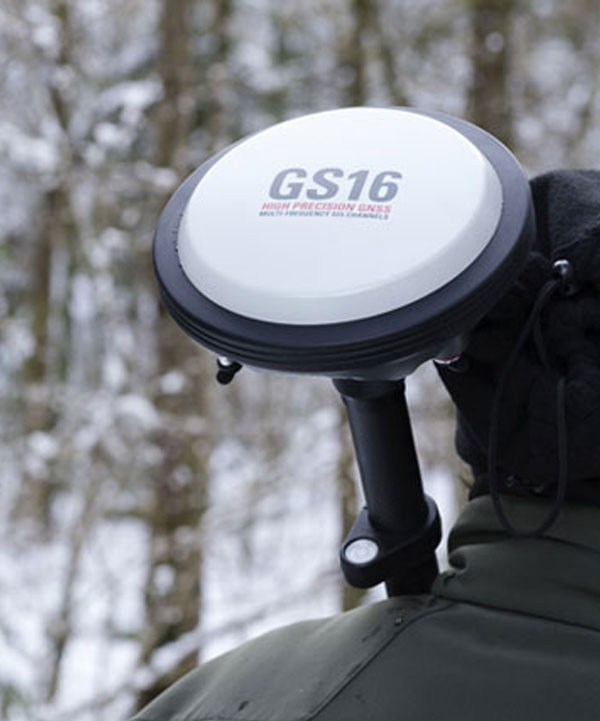
Brand Name : Leica
Model Number : GS16
Country of Origin : Switzerland
System Specification
| GNSS TECHNOLOGY | ||
|---|---|---|
| Self-learning GNSS | Leica RTKplus | Adaptive on-the-fly satellite selection |
| SmartLink (worldwide correction service) | Remote precise point positioning (3 cm 2D)1 Initial convergence to full accuracy typically 18 min, Re-convergence < 1 min |
|
| SmartLink fill (worldwide correction service) | Bridging of RTK outages up to 10 min (3 cm 2D)1 | |
| SmartLink fill (worldwide correction service) | Bridging of RTK outages up to 10 min (3 cm 2D)1 | |
| Leica SmartCheck | Continuous check of RTK solution | Reliability 99.99% |
| Signal tracking | GPS (L1, L2, L2C, L5), Glonass (L1, L2, L2C, L32), | |
| BeiDou (B1, B2, B32), Galileo (E1, E5a, E5b, Alt-BOC, E62), | ||
| ” QZSS (L1, L2C, L5, L62), NavIC L53, SBAS (WAAS, EGNOS, MSAS,GAGAN),L-band “ | ||
| Number of channels | 555 (more signals, fast acquisition, high sensitivity) | |
| MEASUREMENT PERFORMANCE & ACCURACY1 | ||
| Time for initialisation | Typically 4 s | |
| Real-time kinematic | Single baseline | Hz 8 mm + 1 ppm / V 15 mm + 1 ppm |
| (Compliant to ISO17123-8 standard) | Network RTK | Hz 8 mm + 0.5 ppm / V 15 mm + 0.5 ppm |
| Post processing | Static (phase) with long observations | Hz 3 mm + 0.1 ppm / V 3.5 mm + 0.4 ppm |
| Static and rapid static (phase) | Hz 3 mm + 0.5 ppm / V 5 mm + 0.5 ppm | |
| Code differential | DGPS / RTCM | Typically 25 cm |
| COMMUNICATIONS | ||
| Communication ports | Lemo | USB and RS232 serial |
| Bluetooth® | Bluetooth® v2.00 + EDR, class 2 | |
| Communication protocols | RTK data protocols | Leica, Leica 4G, CMR, CMR+, RTCM 2.2, 2.3, 3.0, 3.1, 3.2 MSM |
| NMEA output | NMEA 0183 V 4.00 and Leica proprietary | |
| Network RTK | VRS, FKP, iMAX, MAC (RTCM SC 104) | |
| Built-in data links | 3.75G GSM / UMTS / CDMA phone modem Radio modem |
Fully integrated, internal antenna |
| Fully integrated, receive and transmit, external antenna | ||
| 403 – 473 MHz, 1 W output power, up to 28800 bps over air or | ||
| 902-928 MHz (licence free in North America); up to 1.0 W output power | ||
| External data links | GSM / GPRS / UMTS / CDMA and UHF / VHF modem | |
| GENERAL | ||
| Field controller and software | Leica Captivate software | Leica CS20 field controller, Leica CS35 tablet |
| User interface | Buttons and LEDs | On / Off and Function button, 7 status LEDs |
| Web server | Full status information and configuration options | |
| Data recording | Storage | Removable microSD card, 8 GB |
| Data type and recording rate | Leica GNSS raw data and RINEX data at up to 20 Hz | |
| Power management | Internal power supply | Exchangeable Li-Ion battery (2.6 Ah / 7.4 V) |
| External power supply | Nominal 12 V DC, range 10.5 – 28 V DC | |
| Operation time4 | 7 h receiving (Rx) data with internal radio, 5 h transmitting (Tx) data with internal |
|
| radio, 6 h Rx / Tx data with internal phone modem | ||
| radio, 6 h Rx / Tx data with internal phone modem | ||
| Weight and dimensions | Weight | 0.93 kg / 3.20 kg standard RTK rover setup on pole |
| Diameter x Height | 190 mm x 90 mm | |
| Environmental | Temperature | -40 to 65°C operating, -40 to 80°C storage |
| Drop | Withstands topple over from a 2 m survey pole onto hard surfaces | |
| Proof against water, sand and dust | IP68 (IEC60529 / MIL STD 810G 506.5 I / MIL STD 810G 510.5 I / MIL STD 810G 512.5 I) |
|
| Vibration | Withstands strong vibration (ISO9022-36-08 / MIL STD 810G 514.6 Cat.24) |
|
| Humidity | 100% (ISO9022-13-06 / ISO9022-12-04 / MIL STD 810G 507.5 I) | |
| Functional shock | 40 g / 15 to 23 msec (MIL STD 810G 516.6 I) | |